
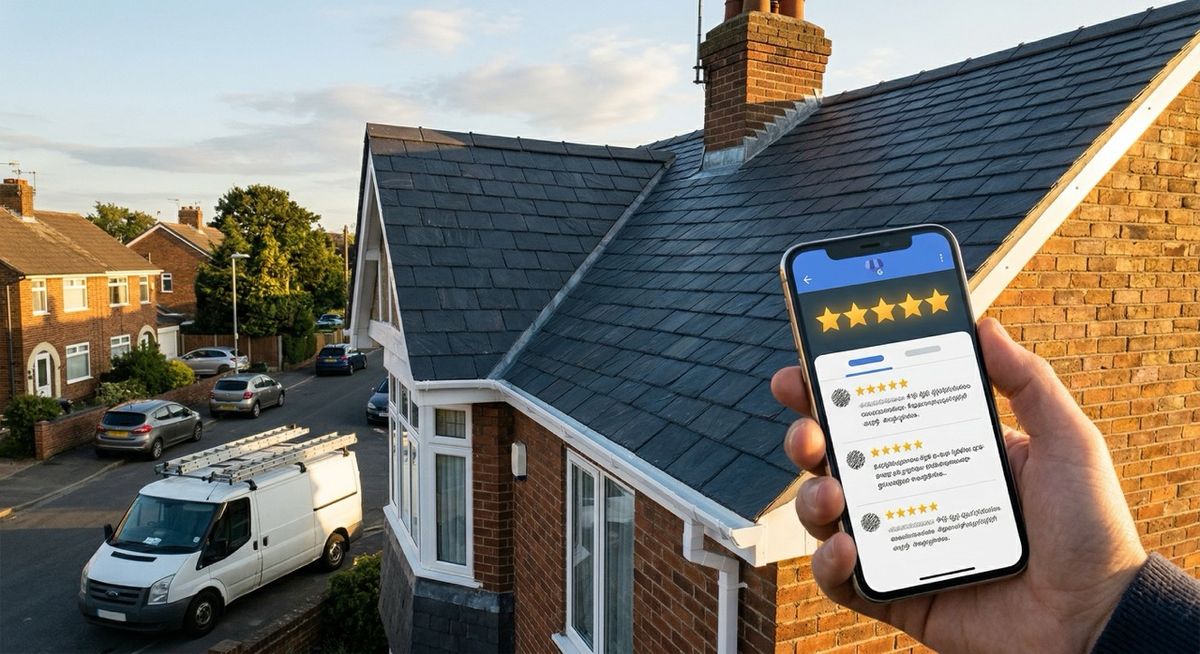
Roofing has a trust problem that most other trades do not face. A plumber fixes a tap and the customer can see it works. An electrician installs a socket and you can plug something in. But when a roofer replaces your ridge tiles or re-felts your flat roof, you are standing in the garden looking up, and you genuinely cannot tell whether the work was done properly.
Checkatrade's own guidance to homeowners spells this out directly: homeowners often struggle to ensure roof work has been carried out to a suitable standard, or even that it needed doing in the first place. That makes roofing what researchers call a "credence good," a service where the customer relies almost entirely on trust rather than direct verification.
In this environment, your Google reviews are not a nice extra. They are the primary mechanism by which strangers decide whether to call you or the firm listed below you.
The trust gap in UK roofing is measurable
Checkatrade's State of Trust in Trades research, polling UK adults, found that only 52% of people said they trusted the tradespeople they worked with. That is across all trades. Roofing sits at the harder end of that spectrum because the work is physically inaccessible and technically difficult for a layperson to assess.
Checkatrade has described roofing as the most complained-about and least trusted trade in its trust research commentary. That is a sector-wide reputation problem, and it affects every roofer, including the ones doing excellent work.
For the customer, the logic is straightforward. If they cannot climb up and check the work themselves, they need someone else to vouch for you. That "someone else" used to be a neighbour's recommendation. Increasingly, it is your Google Business Profile.
How reviews actually drive phone calls
The connection between reviews and revenue is not theoretical. BrightLocal's consumer review survey found that 88% of consumers would use a business that replies to all its reviews, compared with just 47% who would use a business that does not respond to reviews at all. That is nearly double the likelihood of getting the call, based purely on whether you engage with the feedback you have already received.
BrightLocal's 2025 research also found that most consumers check two or more review platforms before making contact. For roofers, that means your review presence on Google, Checkatrade, TrustATrader, and Which? Trusted Traders all contribute to the decision. An inconsistent profile across these platforms (strong on Google, absent on Checkatrade, or vice versa) can trigger distrust rather than confidence.
The UK Competition and Markets Authority has been increasingly active on the topic of online reviews. As reported by the Guardian on 27 March 2026, CMA investigations have emphasised how heavily consumers rely on online feedback before purchasing. Reviews are not just marketing collateral. They are part of the consumer protection infrastructure that shapes purchasing decisions.
What a "good" review profile looks like for a UK roofer
There is no single published figure for the average UK roofer's Google review count. What does exist is Trustmary's benchmark dataset, drawn from over 3 million reviews across 147,000 UK companies. Their recommended targets for home improvement businesses include maintaining a rating above 4.5 stars and generating 30 to 50 new reviews per year per location.
The strategic point is not hitting a national average. It is outperforming your local competition. In most UK towns, the majority of roofing firms have fewer than 20 Google reviews. Many have fewer than 10. If you can consistently generate 3 to 4 reviews per month with thoughtful responses to each one, you will visibly outperform most of your local competitors in search results and in the homeowner's mind.
The star rating matters, but so does recency. A roofer with 40 reviews, all from 2023, looks different from a roofer with 25 reviews, 8 of which are from the last three months. Recency signals that you are still active, still delivering, and still accountable.
Why roofers specifically need to respond to every review
For most trades, responding to reviews is good practice. For roofers, it is closer to essential, because of the credence good problem described earlier.
When a homeowner reads a review that says "replaced our ridge tiles, very professional, cleaned up well" and then sees the business owner reply with specific detail ("glad the new dry ridge system is holding up well, those old mortar beds were in worse shape than they looked from the ground"), it does two things. First, it confirms the review is genuine. Second, it demonstrates technical knowledge that the prospective customer cannot assess any other way.
Every response is an opportunity to demonstrate competence to someone who cannot climb a ladder and check for themselves. That is why BrightLocal's finding (88% vs 47% preference for businesses that respond) hits harder in roofing than in most other trades.
The automated review collection workflow
If you are relying on customers to leave reviews unprompted, you are relying on goodwill and memory, neither of which is reliable. The most effective approach is a simple automated sequence tied to job completion.
When a job is marked as finished (or the invoice is paid), the customer receives an SMS with a direct link to your Google Business Profile review page. Checkatrade describes its own review verification process as confirming over 90% of reviews via SMS or phone, which tells you that SMS is already the standard channel for review collection in UK trade platforms.
A practical sequence looks like this: on the day the job completes, send a thank-you text with a review link. If no review appears within 48 hours, send a single gentle follow-up. If the customer responds with a complaint rather than a review, route that into a private resolution process before it becomes public.
This is not about gaming the system. It is about making it easy for satisfied customers to say so. Most happy customers simply forget, not because they would refuse, but because life moves on. The automated prompt catches them while the scaffolding is still fresh in their memory.
Five steps to build a review profile that sells for you
1. Claim and complete your Google Business Profile. Add photos of completed work (before and after shots of re-roofs, flat roof replacements, guttering renewals). Include your service area, working hours, and a clear description of what you do. An incomplete profile loses to a complete one every time.
2. Set up an automated review request. Trigger it from job completion or invoice payment. SMS works better than email for tradespeople's customers. Keep the message short and include a direct link to your Google review page.
3. Respond to every single review within 48 hours. Positive reviews get a specific, personalised reply (not a generic "thanks for the kind words"). Negative reviews get a professional, solution-focused response. The audience for your response is not the reviewer. It is the next person reading your profile.
4. Cross-pollinate your review presence. Ask some customers to review you on Checkatrade or TrustATrader as well as Google. BrightLocal's research shows consumers check multiple platforms, so a strong profile on just one site leaves gaps.
5. Use before-and-after photos in your responses. When replying to a review, mention specific details about the work ("the new EPDM membrane on the flat roof extension" or "replacing the valley gutter that had been leaking for years"). This builds technical credibility with every response.
If you want to see how your review profile compares and where the gaps are in your online presence, our free roofing business assessment covers it in two minutes.