
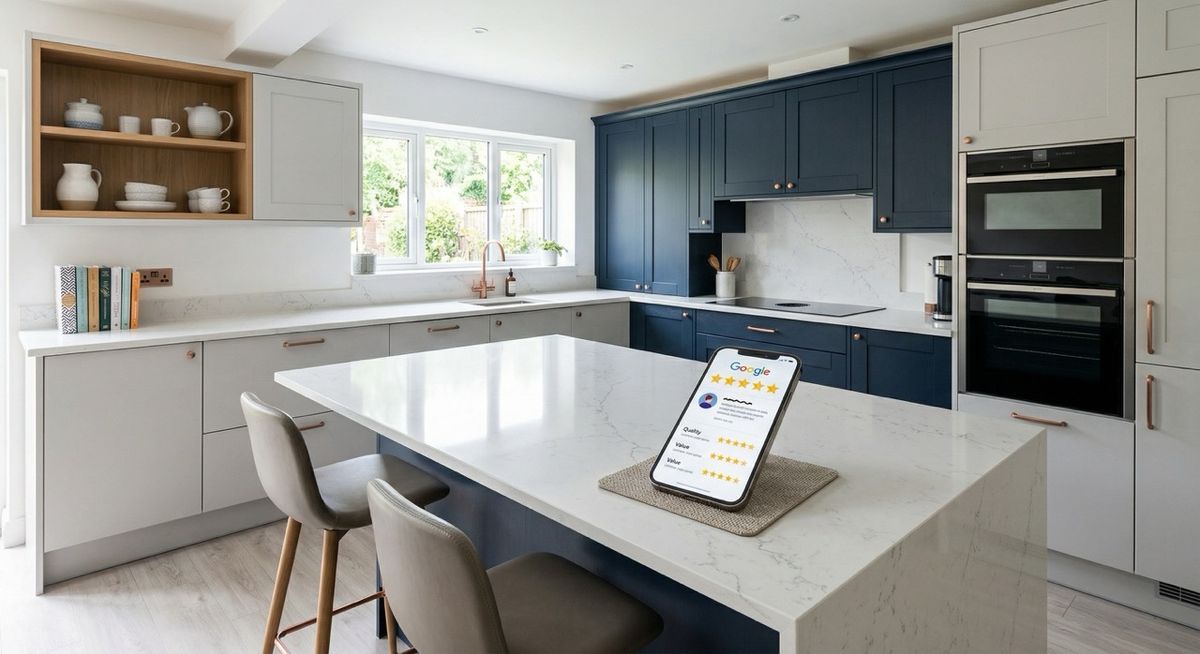
If you fit kitchens and bathrooms, your next customer is almost certainly going to Google you before they call. They will look at your Google Business Profile, check your star rating, read your most recent reviews, and decide whether you are worth contacting.
If what they find is a handful of reviews from two years ago and a 4.0 rating, you are already losing to the competitor down the road with 50 recent five-star reviews and photos of finished kitchens.
This is not speculation. It is how the local search algorithm works, and how consumers make decisions in 2026.
How Google decides who appears in local search
When a homeowner searches for "kitchen fitter near me" or "bathroom renovation [town name]," Google displays its Local Pack: the prominent, map-based widget showing the top three businesses for that search. Getting into those three slots is the difference between being found and being invisible.
Google evaluates local businesses using three factors: relevance, distance, and prominence. Reviews are a critical component of prominence. Google explicitly states that "more reviews and positive ratings can help your business's local ranking."
Industry analysis confirms that Google Reviews contribute approximately 15% of the total weighting for Local Pack ranking. That makes reviews the single most controllable ranking factor after proximity (which you cannot change) and relevance (which depends on your category and listing details).
Even small milestones in review acquisition trigger measurable ranking improvements. Data shows that simply crossing from 9 reviews to 10 results in a noticeable boost in Google Maps visibility. The average local business has approximately 39 reviews. A UK-specific analysis of over 147,000 home improvement and construction businesses found an average of around 20 reviews per business. Businesses that push past these averages capture a disproportionate share of local search traffic.
What consumers actually look at
Beyond the algorithm, reviews act as the primary trust mechanism in a high-risk, high-cost sector. Kitchen and bathroom installations involve large sums of money, significant disruption to the home, and the ever-present fear of "cowboy builders." Research shows that only 52% of consumers genuinely trust the tradespeople they hire. Reviews are how they manage that risk.
The statistics are uncompromising. 60% of UK consumers rank online reviews as the single most influential factor in their buying decisions, ahead of personal recommendations. 71% will refuse to engage a business with an average rating below three stars. And this threshold is rising. The proportion of consumers who demand a minimum of 4.5 stars before even considering a business jumped from 17% to 31% in recent years.
Recency matters as much as the aggregate score. 73% of consumers completely disregard reviews older than one month. A profile with 100 five-star reviews from 2023 will lose out to a profile with 15 five-star reviews from the last three weeks.
For kitchen and bathroom fitters, the implications are direct. Your review profile is not a "nice to have." It is the primary mechanism by which new customers decide whether to contact you, and the primary signal that determines whether Google shows you to them in the first place.
Why manual review collection fails
Despite understanding the importance of reviews, most tradespeople fail to collect them consistently. The typical approach relies on verbally asking the homeowner for a review upon project completion, or sending a manual email a few days later when they remember.
This approach fails for predictable reasons. The request usually arrives long after the customer's emotional high, the excitement of seeing their new kitchen for the first time, has faded. The friction of navigating to Google, logging in, finding the business profile, and typing a review is too high for someone who has already paid their invoice and moved on.
Responding to reviews matters too. 88% of consumers say they would choose a business that responds to all reviews over one that does not respond to any. Yet manually logging into Google Business Profile, checking for new reviews, and drafting individual responses creates an administrative burden that a sole trader or small team cannot sustain without a system.
How automated review collection works
Businesses that implement automated review requests see their review volumes increase by 15% to 25% almost immediately.
The mechanics are simple. When a job is marked as complete (or paid) in the business's system, an automated SMS or email goes to the customer. The message is warm and personal: "Thanks for choosing us for your new kitchen. If you're happy with how it turned out, a quick Google review would really help other homeowners find a reliable fitter. Here's the link: [direct link to Google review form]."
A few days later, if no review has been left, a gentle follow-up is sent. If the feedback is negative, the system routes it to a private channel for resolution before it becomes a public review.
This approach works because it catches the customer while they are still in the "honeymoon phase" of their new installation. It removes the friction of finding the review form. And it runs automatically on every completed job without the installer needing to remember, chase, or spend time on it.
The compounding effect
Over six months, a kitchen and bathroom business completing 8 to 12 jobs per month and achieving a 25% review rate from automated requests would accumulate 12 to 18 new reviews. Over a year, that is 24 to 36. Within 18 months, a business that started with 10 reviews could have 50 or more, all recent, all genuine, all supported by responses.
That shift in review volume directly affects Google Local Pack ranking. Higher ranking drives more search visibility. More visibility generates more enquiries. More enquiries produce more jobs. More completed jobs create more review requests. The cycle feeds itself.
And there is a risk to ignoring it. After a poor call experience, 24% of consumers say they would write a negative review. So responsiveness problems do not just lose today's job. They can create reputation damage that reduces tomorrow's enquiries.
Three things to do this week
1. Check your current position. Search "kitchen fitter [your town]" or "bathroom renovation [your town]" on Google. Where do you appear? How many reviews do you have? What is your average rating? When was the last review posted? If the answers are "low, old, or not appearing," you know where to focus.
2. Ask your last five completed customers. Send a short, personal text or email: "Really pleased with how your kitchen turned out. If you've got two minutes, a quick Google review would really help other homeowners find a reliable fitter. Here's the link." Don't overthink it. Just ask.
3. Automate the process. Build review requests into your job completion workflow so it happens on every job, not just when you remember. A CRM system that triggers an SMS when a job status changes to "complete" removes the reliance on memory and makes review growth predictable.
If you want to see how your business compares on reviews, response speed, and local visibility, our free assessment covers all of it. Ten questions, an instant report, and specific recommendations for what to focus on first.