
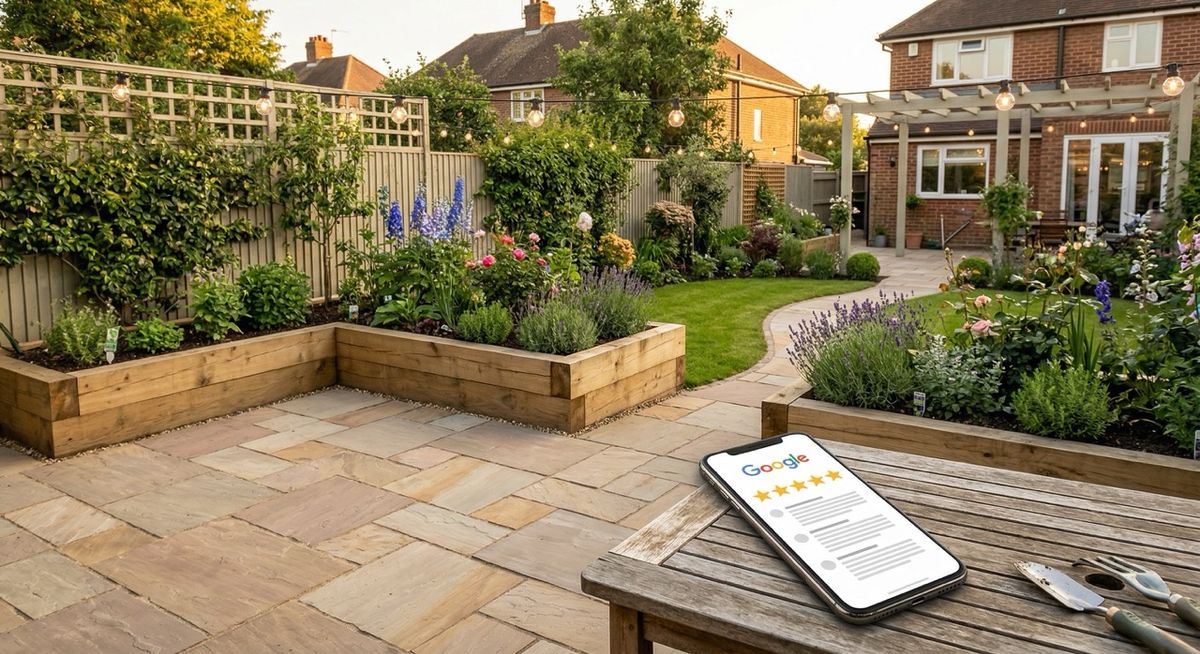
If you landscape gardens, driveways, or patios for a living, your next customer is almost certainly going to Google you before they pick up the phone. They will look at your Google Business Profile, check your star rating, scroll through your most recent reviews, and decide whether you are worth contacting.
If what they find is a handful of reviews from 18 months ago and no photos of finished work, you are already losing to the competitor down the road with 40 recent five-star reviews and a gallery of before-and-after images.
This is not guesswork. It is how the local search algorithm works, and how homeowners make decisions about who to trust with a £10,000 garden project.
How Google decides who appears in local search
When a homeowner searches for "landscaper near me" or "patio installer [town name]," Google displays its Local Pack: the map-based widget showing the top three businesses for that search. Getting into those three slots is the difference between being found and being invisible.
Google evaluates local businesses using three factors: relevance, distance, and prominence. Reviews are a critical component of prominence. Whitespark's Local Search Ranking Factors survey (2023), a widely cited expert study on what drives local pack performance, confirms that review signals (volume, velocity, sentiment, and response behaviour) are material to local visibility. Industry analysis from BrightLocal puts reviews at approximately 13% to 17% of the total weighting for Local Pack ranking. That makes reviews the single most controllable ranking factor after proximity (which you cannot change) and relevance (which depends on your business category).
BrightLocal's 2025 data shows that the average local business has approximately 39 Google reviews. Businesses in the top three Google positions average 47 reviews. For UK home improvement and construction businesses specifically, BrightLocal's analysis of over 147,000 listings found an average of around 20 reviews per business. Pushing past that number gives you a measurable competitive edge in your local market.
What homeowners actually look at before they call
Beyond the algorithm, reviews act as the primary trust mechanism in a high-cost, high-risk sector. Landscaping projects involve significant money, weeks of disruption to the garden, and the ever-present concern about unreliable tradespeople. Homeowners manage that risk by reading reviews carefully.
BrightLocal's Local Consumer Review Survey (2025) found that only 4% of consumers say they never read online reviews for local businesses. Consumers increasingly value photos and videos attached to reviews (reported as up year-on-year) and longer, detailed reviews (also up). 74% of consumers use at least two review platforms, and 34% use three or more. Your potential customer is not just checking Google. They are triangulating across Google, Checkatrade, and your social media profiles.
For landscaping specifically, this triangulation is even more pronounced because the work is inherently visual. Homeowners are not buying hours of labour. They are buying an outcome: a garden that looks like your photos, built by a contractor who matches your professionalism. Houzz UK's landscaping trends research found that 21% of homeowners hired specialists for decking and patios, 18% for stone and paving, and 17% for fencing and gates. These are outcome-driven purchases, and the decision starts with visual proof.
The penalty for a weak review profile is severe. BrightLocal's research shows that 71% of consumers will not consider a business with an average rating below three stars. 73% of consumers disregard reviews older than one month. A profile with 30 five-star reviews from 2024 will lose to a profile with 12 five-star reviews from the last three weeks.
Why manual review collection fails every time
Despite understanding the importance of reviews, most landscapers fail to collect them consistently. The typical approach is asking the homeowner verbally at the end of a project, or sending a text a few days later when you remember.
This approach fails for predictable reasons. The request usually arrives after the customer's emotional high (the excitement of seeing their finished garden for the first time) has faded. The friction of navigating to Google, logging in, finding your profile, and typing a review is too high for someone who has already paid the invoice and moved on.
BrightLocal's 2025 report found that 84% of satisfied customers will not leave a review unless they are explicitly and conveniently prompted. The problem is almost never willingness. It is friction.
Responding to reviews matters too. BrightLocal's data shows that 88% of consumers would choose a business that responds to all its reviews over one that does not respond to any. Yet manually logging into Google Business Profile, checking for new reviews, and drafting individual responses creates an administrative burden that a sole trader or small team simply cannot sustain.
How automated review collection works
Businesses that implement automated review requests see their review volumes increase significantly and predictably.
The mechanics are straightforward. When a job is marked as complete in your system, an automated SMS or email goes to the customer. The message is warm and specific: "Thanks for choosing us for your new patio. If you're happy with how it turned out, a quick Google review would really help other homeowners find a reliable landscaper. Here's the link: [direct link to Google review form]."
A few days later, if no review has been left, a gentle follow-up is sent. If the feedback is negative, the system routes it to a private channel for resolution before it becomes a public review.
This approach works because it catches the customer at the right moment. In landscaping, your work is completed in clear "moments of delight": the reveal, the before-and-after contrast, the first evening spent on the new patio, the solved drainage issue. Timing the review request to coincide with that emotional high, typically within 24 to 48 hours of project handover, dramatically increases response rates.
BrightLocal's 2025 report explicitly references automated review prompts as an emerging opportunity for trades and service businesses. The operational discipline is simple: trigger the request at handover, make it one-click, and include a couple of your best project photos in the message to prompt the customer to reference them in their review.
The compounding effect
Over six months, a landscaping business completing 6 to 10 jobs per month and achieving a 25% review rate from automated requests would accumulate 9 to 15 new reviews. Over a year, that is 18 to 30. Within 18 months, a business that started with 10 reviews could have 50 or more, all recent, all genuine, all supported by responses.
That shift in review volume directly affects Google Local Pack ranking. Higher ranking drives more search visibility. More visibility generates more enquiries. More enquiries produce more jobs. More completed jobs create more review requests. The cycle feeds itself.
There is also a risk to ignoring it. The longer you wait, the wider the gap grows between you and the competitor who automated their review collection a year ago. Local search ranking is relative. Every review they gain while you stay still pushes you further down the results.
Three things to do this week
1. Check your current position. Search "landscaper [your town]" or "patio installer [your town]" on Google. Where do you appear? How many reviews do you have? What is your average rating? When was the last review posted? If the answers are "low, old, or not appearing," you know where to focus.
2. Ask your last five completed customers. Send a short, personal text: "Really pleased with how your garden turned out. If you've got two minutes, a quick Google review would really help other homeowners find a reliable landscaper. Here's the link." Do not overthink it. Just ask.
3. Automate the process. Build review requests into your job completion workflow so it happens on every job, not just when you remember. A CRM system that triggers an SMS when a job status changes to "complete" removes the reliance on memory and makes review growth predictable.
If you want to see how your business compares on reviews, response speed, and local visibility, our free assessment covers all of it. Ten questions, an instant report, and specific recommendations for what to focus on first.