
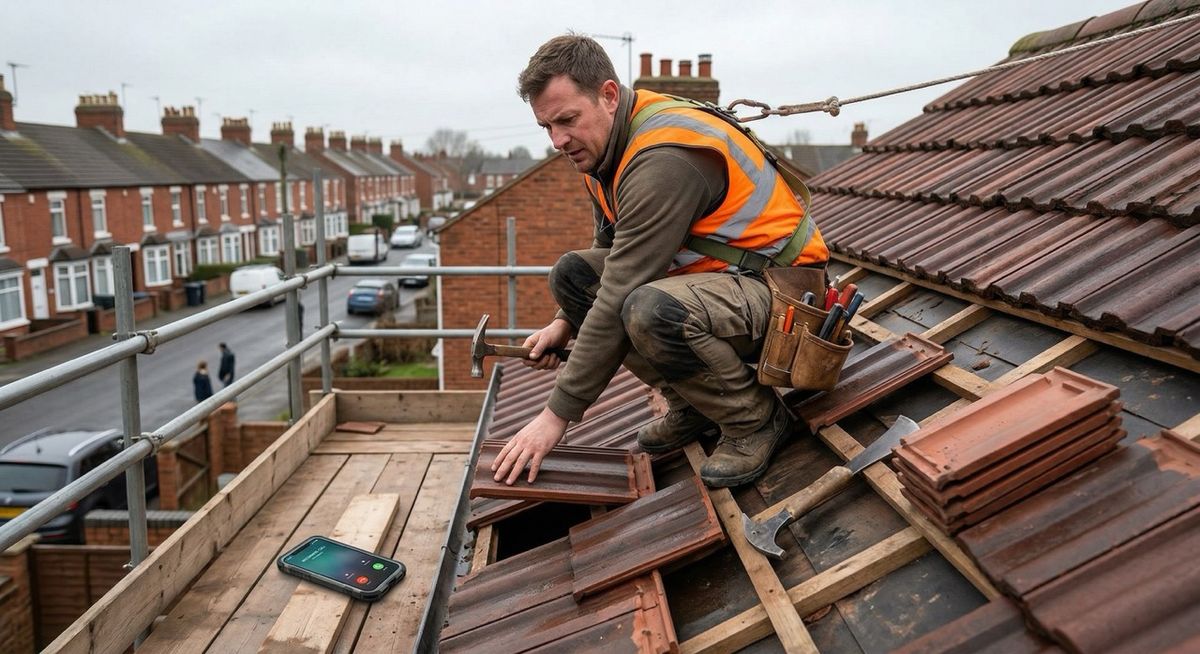
If you run a roofing business, here is a number worth sitting with. A study commissioned by TelePA, covering 142 UK small businesses, found that 47% failed to answer the initial incoming call. Nearly half.
That is not a stat about bad customer service. It is a stat about lost revenue. In an industry where a full roof replacement averages £7,000 according to Checkatrade's UK consumer pricing data (with typical homeowner spend ranging from £4,000 to £19,000), even one missed enquiry per week can cost you tens of thousands over the course of a year.
And the callers who do not get through? Most of them are gone for good. Moneypenny's UK consumer research found that 54% of callers will not leave a voicemail if they cannot reach someone. They do not wait. They scroll to the next Google result and call your competitor.
Why roofers miss more calls than they realise
The reason is structural, not personal. You are on a scaffold, stripping old tiles in the wind, or up a ladder with both hands full. You cannot safely take a call while working at height, and you should not try.
Fix Radio's survey of over 220 UK tradespeople confirmed what most roofers already know from experience: 60% said they struggle to answer calls while at work, and 34% believed they had directly lost work because of it. That is tradespeople themselves recognising the revenue impact, not just a theory from a marketing consultant.
The problem gets worse during your busiest periods. Storm season, the weeks after heavy rainfall, spring re-roof season: these are the times when your phone rings most and you are least available to answer it. Your highest-demand periods are your highest-leakage periods.
Two types of caller, two types of loss
Roofing leads split into two distinct categories, and both are damaged by missed calls, but in different ways.
Emergency callers (leaks, storm damage, tiles blown off) are in distress. They need someone now. Research from Moneypenny found that 35% of UK consumers say their biggest frustration is calls not being answered. For a homeowner with water coming through the ceiling, that frustration turns into immediate action: they hang up and dial the next roofer. The Gemini research report on UK roofing (2026) describes this as "sequential dialling," where 67% of distressed consumers automatically select the first business that responds.
Planned callers (full re-roofs, flat roof replacements, guttering renewals) have more patience, but less than you think. These are homeowners spending £4,000 to £19,000. They are comparing availability, professionalism, and responsiveness before they even get to price. If you take two days to return their call, you have already told them something about how you run your business.
The financial cost in real terms
A roofing business receiving 12 enquiry calls per week with a 47% missed call rate loses roughly 5 to 6 calls weekly. If 54% of those missed callers never leave a voicemail, that is 3 leads vanishing every week without a trace.
At a blended average job value of £3,500 (factoring in a mix of emergency repairs, flat roof sections, and larger re-roof quotes) and a 30% conversion rate on calls you do answer, those 3 invisible lost leads cost you roughly one additional job per week. Over a 48-week year, that adds up to approximately £168,000 in lost gross revenue.
Even a smaller operation missing just 2 calls per week at an average job value of £2,000 and a 25% close rate is leaving over £48,000 per year on the table. That revenue went to whoever picked up first.
Speed is the deciding factor, not price
The damage is not limited to completely unanswered calls. Delayed responses are almost as costly.
Research published in Harvard Business Review, covering 1.25 million sales leads, found that businesses responding within one hour were nearly seven times more likely to qualify that lead than those who waited longer. A separate MIT study found that calling within five minutes increased contact odds by 100 times compared to waiting 30 minutes.
For most roofers, the typical call-back window is "after I get off the roof," which realistically means 6 to 10 hours later. By then, the emergency customer has already booked someone else. The planned customer has spoken to two other firms and formed a first impression of each.
In a UK market with over 12,000 active roofing businesses (IBISWorld, 2025), the homeowner is not struggling for options. The Gemini research (2026) puts it plainly: the first credible responder captures the lead at a rate that dwarfs any price advantage you might offer later.
Your advertising budget is leaking from the same hole
If you spend £600 per month on Google Ads at a cost per lead of £35, that should generate around 17 leads. With a 47% missed call rate, roughly 8 of those leads never get a conversation. Your actual cost per reachable lead jumps from £35 to nearly £70. You are paying to make the phone ring, then letting it ring out.
This is why many roofers conclude that "Google Ads do not work" or "Checkatrade is a waste of money." The lead generation worked perfectly. The lead capture failed completely.
What to do this week
You do not need to come off the roof to fix this. Three steps will close the biggest gap immediately.
1. Check your missed call rate. Look at your phone's call log for the last 30 days. Count incoming calls during working hours that you did not answer. Count how many left a voicemail. If more than 30% went unanswered and fewer than half of those left messages, you have a significant revenue leak you cannot see.
2. Set up a missed-call text-back. When a call goes unanswered, an automatic SMS fires within seconds: "Sorry I missed your call, I'm up on a job right now. I'll ring you back within the hour. If it's urgent, reply with your postcode and a quick description and I'll prioritise it." This single automation keeps the lead warm inside the critical first-hour window that the Harvard Business Review research identifies as decisive.
3. Consider an Ai receptionist or virtual answering service. A system that answers when you cannot, captures the caller's details (postcode, type of work, urgency level), and books a callback slot directly into your calendar. Unlike voicemail, it gives the caller an immediate response. Businesses using automated call handling have reported their missed call rates dropping to near zero.
If you want to see where your roofing business stands on call handling, response speed, and lead capture, our free assessment takes two minutes. Ten questions, an instant score, and a clear picture of what to fix first.