
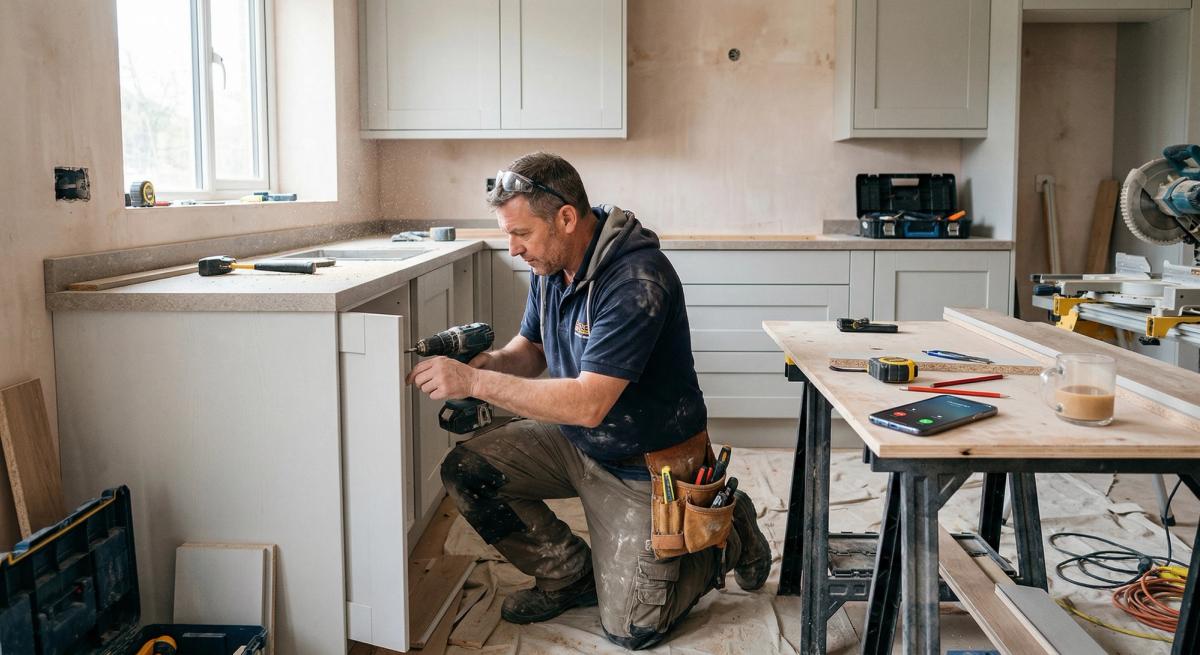
If you fit kitchens or bathrooms for a living, here is a number that should stop you in your tracks. Research into UK home services businesses found that up to 62% of inbound telephone calls go completely unanswered during standard working hours.
Not answered slowly. Not answered badly. Not answered at all.
In most industries, a missed call is a minor inconvenience. In kitchen and bathroom installation, where a single job can be worth £10,000 to £35,000 or more, every unanswered phone is potential revenue walking straight to a competitor.
Why the calls go unanswered
The reason is structural, not careless. A kitchen fitter cannot safely or practically answer a mobile phone while operating a circular saw, fitting a worktop, or consulting with a client on site. The physical demands of the trade make it impossible to be on the tools and on the phone at the same time.
So the calls go to voicemail. And here is where the problem becomes catastrophic: research shows that 85% of consumers will refuse to leave a voicemail or attempt to call back. They simply return to their Google results and dial the next number on the list. Moneypenny's Small Business Call Report, based on a survey of 300 micro-businesses and analysis of 10,000 businesses' call data, found that 33% of micro-businesses failed to answer incoming calls, and 69% of callers who reached voicemail declined to leave a message.
The industry's own co-founder describes voicemail as the equivalent of "tearing up money." When callers cannot get through, they ring the next supplier on the list.
The financial maths
This is where kitchen and bathroom installation differs from almost every other small business. The average order value is exceptionally high. A budget full kitchen renovation averages around £11,500. A mid-range kitchen sits between £12,000 and £25,000. A bespoke kitchen can exceed £35,000 to £50,000. Even a standard bathroom renovation runs to £4,500 to £7,000.
Consider a straightforward scenario. An installer receives 20 inbound enquiry calls per week. With a 50% missed call rate (lower than the 62% industry average), 10 of those calls go unanswered. If 85% of those callers refuse to leave a voicemail, 8.5 leads are lost instantly. With a 30% conversion rate on the calls that do get answered, the installer wins approximately 3.5 jobs per week.
Now compare that to an installer who captures every single call through an automated system. All 20 leads are reached. At the same 30% conversion rate, that installer wins 6 jobs per week. The difference is 2.5 jobs per week. Over a 48-week working year, at an average blended project value of £10,000, that gap is worth £1.2 million in gross revenue.
Scale the numbers down to a sole trader missing just five calls a week with an average job value of £5,000 and a 20% close rate, and the annual hidden loss still exceeds £48,000. These are not hypothetical figures. They are the direct, predictable consequence of a business model that relies on a single person answering the phone while simultaneously doing physical work.
Speed is the decisive factor
The financial damage is not limited to calls that go unanswered. Even when an installer does return a missed call, the delay matters enormously.
Research published in Harvard Business Review found that firms contacting a lead within one hour were nearly seven times more likely to qualify that lead than those who waited even an hour longer, and more than 60 times more likely than those who waited 24 hours. A separate study from MIT found that calling within five minutes increased the odds of contacting a lead by 100 times, and qualifying by 21 times, compared to waiting just 30 minutes.
For kitchen and bathroom installers, the 24-hour delay is not unusual. It is standard practice. Most sole traders and small teams catch up on missed calls during transit between jobs or late in the evening. By that point, the prospect has already spoken to two or three competitors, and research indicates that 78% of consumers go with the first business that responds to their enquiry.
The correlation between response time and conversion degrades exponentially. Contacting a prospect within the first minute yields a 391% increase in conversion probability compared to no structured follow-up. By 30 minutes, the advantage has dropped to 62%. By 24 hours, it is a negligible 17%.
The marketing budget that burns itself
The financial damage extends beyond lost revenue. It actively destroys working marketing capital.
Many kitchen and bathroom businesses invest in Google Ads, local SEO, Checkatrade listings, and social media advertising to generate enquiries. If an installer spends £1,000 on Google Ads at a cost per lead of £50, that should generate 20 leads. But with a 62% missed call rate, roughly 12 of those leads never get a conversation. The installer has effectively burned £600 of their marketing budget without ever speaking to the prospect.
The actual cost per reachable lead jumps from £50 to over £130. This leads many business owners to conclude that "Google Ads don't work" or "marketing is a waste of money," when the failure lies entirely in their lead capture infrastructure. They are paying top-tier prices to make the phone ring, then letting it ring out.
What to do this week
You don't need to hire a receptionist or stop working to fix this. Here are three steps that target the biggest revenue leaks immediately.
1. Measure your missed call rate. Check your phone's call log for the last 30 days. How many incoming calls went unanswered? How many of those callers left a voicemail? How many called back? If you cannot answer these questions, you have no visibility on the single biggest revenue leak in your business.
2. Set up a missed-call text-back. When a call goes unanswered, an automatic SMS goes to the caller within seconds: "Sorry I couldn't pick up, I'm on a job right now. I'll call you back within the hour. In the meantime, you can book a site visit here: [link]." This single automation can recover a significant percentage of leads that would otherwise call the next installer on the list.
3. Consider an answering service or Ai receptionist. A virtual receptionist or Ai-powered call handler can answer when you cannot, capture job details, and book a site visit directly into your calendar. Unlike voicemail, it provides the immediate human (or near-human) response that callers expect. Businesses deploying automated call handling have seen missed call rates drop to near zero, with revenue increases of 10% to 25%.
If you want to find out where your business stands on call handling, response speed, and lead capture, our free assessment takes two minutes. Ten questions, an instant report, and a clear picture of what to fix first.